The Italian-built multi-purpose logistics module (MPLM) called Leonardo was built to serve the same purpose as its two brothers, Rafaello and Donatello: to ferry supplies, equipment, experiments and other cargo to and from the International Space Station via the space shuttle's payload bay. Now the module formerly known as Leonardo is on its way to a permanent assignment in space.
An MPLM is designed to be carried to the space station by a shuttle, be temporarily attached to the station to allow astronauts to float inside and remove cargo and fill it back up with items, and then be detached and returned to Earth by the shuttle.
"For many years, NASA and the Italian Space Agency have been looking at the potential of turning one of the multi-purpose logistics modules into a permanent module to fly and attach to the station and leave behind," says Scott Higginbotham, the payload mission manager for space shuttle Discovery’s STS-133 flight. "Efforts to actually conduct the conversion got serious in the summer of 2009 when we started studies to understand specifically what modifications would be necessary to make the conversion from a temporary visiting vehicle to a permanent vehicle."
Once the conversion plan was approved, the Italian Space Agency contracted with Thales Alenia Space, the European company that originally built the module, to perform the majority of the modifications.
"There are three basic types of modifications that were performed to make the conversion from the MPLM to the PMM (Permanent Multipurpose Module)," explains Higginbotham. "The first has to do with weight. We tried to reduce the weight of the module as much as possible by eliminating hardware that we didn't need for the long-duration stay on orbit to allow us to carry more useful cargo up to space on STS-133."
The second set of modifications was aimed at making the module's interior more user-friendly to the station crew members. "For example, we have modified some of the panels inside the vehicle so that they are much easier for the astronauts to open and close during a flight," says Higginbotham.
But by far the biggest change was preparing the PMM to spend 10 years exposed to the rigors of space instead of the 10 days it might previously have been outside the protection of the shuttle during a mission.
"Probably most significantly we had to armor the exterior of the module so that it can withstand the micrometeoroid and hypervelocity debris impacts over the 10 years that it'll be on the station," says Higginbotham, "Rather than modify the external shields, which are made of metal, which was going to be heavy and expensive, the clever idea that both we and the Italians came up with was to install a micrometeoroid mattress, which is basically a bullet-proof vest for the station that lies underneath the metallic shield and on top of the pressure vessel."
When the modifications are completed, the module will be loaded with the STS-133 payload and fly aboard Discovery, remaining at the station at the end of the mission. The extra space it provides will give the station's resident crew what amounts to a giant new float-in closet to help store supplies, equipment and potentially experiments aboard the orbiting laboratory, helping the station continue its mission through the decade.
NASA's Kepler spacecraft has discovered the first confirmed planetary system with more than one planet crossing in front of, or transiting, the same star
The transit signatures of two distinct planets were seen in the data for the sun-like star designated Kepler-9. The planets were named Kepler-9b and 9c. The discovery incorporates seven months of observations of more than 156,000 stars as part of an ongoing search for Earth-sized planets outside our solar system. The findings will be published in Thursday's issue of the journal Science.
Kepler's ultra-precise camera measures tiny decreases in the stars' brightness that occur when a planet transits them. The size of the planet can be derived from these temporary dips.
The distance of the planet from the star can be calculated by measuring the time between successive dips as the planet orbits the star. Small variations in the regularity of these dips can be used to determine the masses of planets and detect other non-transiting planets in the system.
In June, mission scientists submitted findings for peer review that identified more than 700 planet candidates in the first 43 days of Kepler data. The data included five additional candidate systems that appear to exhibit more than one transiting planet. The Kepler team recently identified a sixth target exhibiting multiple transits and accumulated enough follow-up data to confirm this multi-planet system.
"Kepler's high quality data and round-the-clock coverage of transiting objects enable a whole host of unique measurements to be made of the parent stars and their planetary systems," said Doug Hudgins, the Kepler program scientist at NASA Headquarters in Washington.
Scientists refined the estimates of the masses of the planets using observations from the W.M. Keck Observatory in Hawaii. The observations show Kepler-9b is the larger of the two planets, and both have masses similar to but less than Saturn. Kepler-9b lies closest to the star with an orbit of about 19 days, while Kepler-9c has an orbit of about 38 days. By observing several transits by each planet over the seven months of data, the time between successive transits could be analyzed.
"This discovery is the first clear detection of significant changes in the intervals from one planetary transit to the next, what we call transit timing variations," said Matthew Holman, a Kepler mission scientist from the Harvard-Smithsonian Center for Astrophysics in Cambridge, Mass. "This is evidence of the gravitational interaction between the two planets as seen by the Kepler spacecraft."
In addition to the two confirmed giant planets, Kepler scientists also have identified what appears to be a third, much smaller transit signature in the observations of Kepler-9. That signature is consistent with the transits of a super-Earth-sized planet about 1.5 times the radius of Earth in a scorching, near-sun 1.6 day-orbit. Additional observations are required to determine whether this signal is indeed a planet or an astronomical phenomenon that mimics the appearance of a transit.
NASA's Ames Research Center in Moffett Field, Calif., manages Kepler's ground system development, mission operations and science data analysis. NASA's Jet Propulsion Laboratory in Pasadena, Calif., managed Kepler mission development.
Ball Aerospace and Technologies Corp. in Boulder, Colo., developed the Kepler flight system and supports mission operations with the Laboratory for Atmospheric and Space Physics at the University of Colorado in Boulder. The Space Telescope Science Institute in Baltimore archives, hosts and distributes the Kepler science data.
For more information about the Kepler mission, visit:
"Avatar" Director And NASA Focus On Earth Science Exploration In Psa Campaign
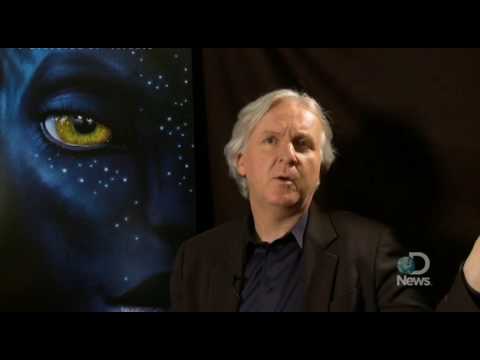
WASHINGTON -- James Cameron, director of "Avatar," the most successful film ever released, is featured in a series of new NASA public service announcements that describe the many contributions of the agency's Earth science program to environmental awareness and exploration of our home planet.
"When NASA ventures into space, it remembers to keep a steady eye on home," Cameron said. "Its fleet of Earth-orbiting satellites constantly reveals our whole planet: its remotest places, its mysteries and the powerful influence of humans."
Cameron's 3-D epic, based on the fictional planet of Pandora and is coming back to theaters this week. The story centers on a beautiful planet threatened by forces that want to exploit its natural resources.
The public service announcements feature "Avatar" film imagery and include computer animations and data from NASA's fleet of Earth-observing satellites. NASA has 14 science satellites in orbit making cutting-edge global observations of the entire global system including the atmosphere, oceans, land surface, snow and ice.
NASA Television will broadcast the announcements beginning Tuesday and they are available to television and radio stations, and other interested media outlets.
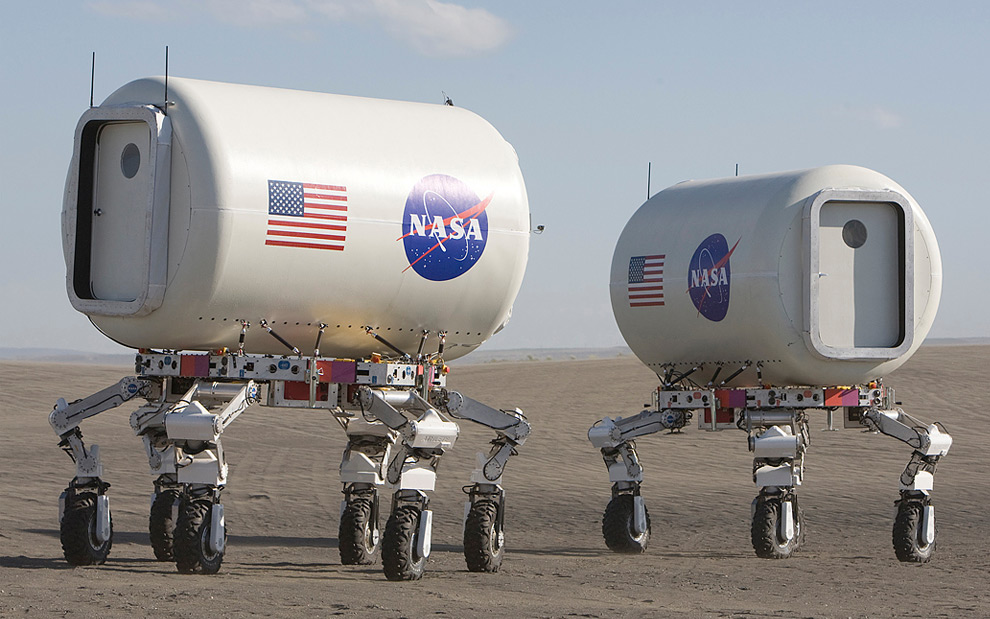
Engineers from NASA's Jet Propulsion Laboratory are currently putting their All-Terrain, Hex-Limbed, Extra-Terrestrial Explorer (ATHLETE) through a series of long-drive tests on the long, dirt roads found adjacent to JPL. The JPL grounds do not include an unpaved area of sufficient size for testing such a large robot over a long distance. Some of the dirt roads in the Arroyo Seco (a wash located next to JPL) are wide enough for ATHLETE, and its close proximity to JPL allows the robot to be secured in its hangar between test runs.
The engineers want to test the moon rover's ability to meet a NASA milestone of traveling at least 40 kilometers (25 miles) over 14 days under its own power. The official demonstration is slated to begin in the Arizona high desert next month.
ATHLETE is a 1/2-scale working prototype of a robot under development to transport habitats and other cargo on the surface of the Moon or Mars. The ATHLETE concept is a level cargo deck carried by six wheels, each on the end of a configurable leg. The prototype stands approximately 4.5 meters (15 feet) tall and 4.5 meters (15 ft) wide and weighs about (about 2,300 kilograms (2.5 tons). The robot moves relatively slowly, with a top speed during traverse of approximately 2 kilometers per hour (1.25 mph).
It takes a lot of hard work, ingenuity and creativity to build a rover like ATHLETE. And it takes a lot of creativity of a different sort to make ATHLETE "dance." See the results of that effort in a fast-action video of ATHLETE bustin' a move.
PASADENA, Calif. -- Tight double-star systems might not be the best places for life to spring up, according to a new study using data from NASA's Spitzer Space Telescope. The infrared observatory spotted a surprisingly large amount of dust around three mature, close-orbiting star pairs. Where did the dust come from? Astronomers say it might be the aftermath of tremendous planetary collisions.
"This is real-life science fiction," said Jeremy Drake of the Harvard-Smithsonian Center for Astrophysics, Cambridge, Mass. "Our data tell us that planets in these systems might not be so lucky -- collisions could be common. It's theoretically possible that habitable planets could exist around these types of stars, so if there happened to be any life there, it could be doomed."
Drake is the principal investigator of the research, published in the Aug.19 issue of the Astrophysical Journal Letters.
The particular class of binary, or double, stars in the study are about as snug as stars get. Named RS Canum Venaticorums, or RS CVns for short, they are separated by only about two million miles (3.2 million kilometers), or two percent of the distance between Earth and our sun. The stellar pairs orbit around each other every few days, with one face on each star perpetually locked and pointed toward the other.
The close-knit stars are similar to the sun in size and are probably about a billion to a few billion years old -- roughly the age of our sun when life first evolved on Earth. But these stars spin much faster, and, as a result, have powerful magnetic fields, and giant, dark spots. The magnetic activity drives strong stellar winds -- gale-force versions of the solar wind -- that slow the stars down, pulling the twirling duos closer over time. And this is where the planetary chaos may begin.
As the stars cozy up to each other, their gravitational influences change, and this could cause disturbances to planetary bodies orbiting around both stars. Comets and any planets that may exist in the systems would start jostling about and banging into each other, sometimes in powerful collisions. This includes planets that could theoretically be circling in the double stars' habitable zone, a region where temperatures would allow liquid water to exist. Though no habitable planets have been discovered around any stars beyond our sun at this point in time, tight double-star systems are known to host planets; for example, one system not in the study, called HW Vir, has two gas-giant planets.
"These kinds of systems paint a picture of the late stages in the lives of planetary systems," said Marc Kuchner, a co-author from NASA Goddard Space Flight Center in Greenbelt, Md. "And it's a future that's messy and violent."
Spitzer spotted the infrared glow of hot dusty disks, about the temperature of molten lava, around three such tight binary systems. One of the systems was originally flagged as having a suspicious excess of infrared light in 1983 by the Infrared Astronomical Satellite. In addition, researchers using Spitzer recently found a warm disk of debris around another star that turned out to be a tight binary system.
The astronomy team says that dust normally would have dissipated and blown away from the stars by this mature stage in their lives. They conclude that something -- most likely planetary collisions -- must therefore be kicking up the fresh dust. In addition, because dusty disks have now been found around four, older binary systems, the scientists know that the observations are not a fluke. Something chaotic is very likely going on.
If any life forms did exist in these star systems, and they could look up at the sky, they would have quite a view. Marco Matranga, first author of the paper, from the Harvard-Smithsonian Center for Astrophysics and now a visiting astronomer at the Palermo Astronomical Observatory in Sicily, said, "The skies there would have two huge suns, like the ones above the planet Tatooine in 'Star Wars.'"
Other authors include V.L. Kashyap of the Harvard-Smithsonian Center for Astrophysics; and Massimo Marengo of Iowa State University, Ames.
The Spitzer observations were made before it ran out of its liquid coolant in May 2009, officially beginning its warm mission.
NASA's Jet Propulsion Laboratory, Pasadena, Calif., manages the Spitzer Space Telescope mission for NASA's Science Mission Directorate, Washington. Science operations are conducted at the Spitzer Science Center at the California Institute of Technology, also in Pasadena. Caltech manages JPL for NASA. For more information about Spitzer, visit http://spitzer.caltech.edu/ and http://www.nasa.gov/spitzer .
The Infrared Astronomical Satellite, known commonly by its acronym, IRAS, was a joint project between NASA, the Netherlands and the United Kingdom.
Imagine floating 35,000 miles above the sunny side of Earth. Our home planet gleams below, a majestic whorl of color and texture. All seems calm around you. With no satellites or space debris to dodge, you can just relax and enjoy the black emptiness of space.
But looks can be deceiving.
In reality, you've unknowingly jumped into an invisible mosh pit of electromagnetic mayhem — the place in space where a supersonic "wind" of charged particles from the Sun crashes head-on into the protective magnetic bubble that surrounds our planet. Traveling at a million miles per hour, the solar wind's protons and electrons sense Earth's magnetosphere too late to flow smoothly around it. Instead, they're shocked, heated, and slowed almost to a stop as they pile up along its outer boundary, the magnetopause, before getting diverted sideways.
Space physicists have had a general sense of these dynamic goings-on for decades. But it wasn't until the advent of the Interstellar Boundary Explorer or IBEX, a NASA spacecraft launched in October 2008, that they've been able to see what the human eye cannot: the first-ever images of this electromagnetic crash scene. They can now witness how some of the solar wind's charged particles are being neutralized by gas escaping from Earth's atmosphere.
A New Way to See Atoms
IBEX wasn't designed to keep tabs on Earth's magnetosphere. Instead, its job is to map interactions occurring far beyond the planets, 8 to 10 billion miles away, where the Sun's own magnetic bubble, the heliosphere, meets interstellar space.
Only two spacecraft, Voyagers 1 and 2, have ventured far enough to probe this region directly. IBEX, which travels in a looping, 8-day-long orbit around Earth, stays much closer to home, but it carries a pair of detectors that can observe the interaction region from afar.
Here's how: When fast-moving protons in the solar wind reach the edge of the heliosphere, they sometimes grab electrons from the slower-moving interstellar atoms around them, like batons getting passed between relay runners. This charge exchange creates electrically neutral hydrogen atoms that are no longer controlled by magnetic fields. Suddenly, they're free to go wherever they want — and because they're still moving fast, they quickly zip away from the interstellar boundary in all directions.
This animation shows a neutral solar particle's path leaving the Sun, following the magnetic field lines out to the Heliosheath. The solar particle hits a hydrogen atom, stealing it's electron and we follow it until we see it hit one of IBEXs detectors. Credit: NASA/Goddard Space Flight Center
Some of these "energetic neutral atoms," or ENAs, zip past Earth, where they're recorded by IBEX. Its two detectors don't take pictures with conventional optics. Instead, they record the number and energy of atoms arriving from small spots of sky about 7 degrees across (the apparent size of a tennis ball held at arm's length). Because its spin axis always points at the Sun, the spacecraft slowly turns throughout Earth's orbit and its detectors scan overlapping strips that create a complete 360 degrees map every six months.
A Collision Zone Near Earth
Because IBEX is orbiting Earth, it also has a front-row seat for observing the chaotic pileup of solar-wind particles occurring along the "nose" of Earth's magnetopause, about 35,000 miles out. ENAs are created there too, as solar-wind protons wrest electrons from hydrogen atoms in the outermost vestiges of our atmosphere, the exosphere.
Other spacecraft have attempted to measure the density of the dayside exosphere, without much success. NASA's Imager for Magnetopause-to-Aurora Global Exploration (IMAGE) spacecraft probably detected ENAs from this region a decade ago, but its detectors didn't have the sensitivity to pinpoint or measure the source.
Now, thanks to IBEX, we know just how tenuous the outer exosphere really is. "Where the interaction is strongest, there are only about eight hydrogen atoms per cubic centimeter," explains Stephen A. Fuselier, the Lockheed Martin Space Systems researcher who led the mapping effort. His team's results appear in the July 8 issue of Geophysical Research Letters.
The key observations were made in March and April 2009, when IBEX was located far from Earth — about halfway to the Moon's orbit — and its detectors could scan the region directly in front of the magnetopause. During some of the March observations, the European Space Agency's Cluster 3 spacecraft was positioned just in front of the magnetopause, where it measured the number of deflected solar-wind protons directly. "Cluster played a very important role in this study," Fuselier explains. "It was in the right place at the right time."
The new IBEX maps show that the ENAs thin out at locations away from the point of peak intensity. This falloff makes sense, Fuselier says, because Earth's magnetopause isn't spherical. Instead, it has a teardrop shape that's closest to Earth at its nose but farther away everywhere else. So at locations well away from the magnetopause's centerline, even fewer of the exosphere's hydrogen atoms are hanging around to interact with the solar wind. "No exosphere, no ENAs," he explains.
A Versatile Spacecraft
Since its launch, IBEX has also scanned another nearby world, with surprising results. The moon has no atmosphere or magnetosphere, so the solar wind slams unimpeded into its desolate surface. Most of those particles get absorbed by lunar dust. In fact, space visionaries wonder if the moon's rubbly surface has captured enough helium-3, an isotope present in tiny amounts in the Sun's outflow, to serve as a fuel for future explorers.
Yet cosmic chemists have long thought that some solar-wind protons must be bouncing off the lunar surface, becoming ENAs through charge exchange as they do. So does the moon glow in IBEX's scans? Indeed it does, says David J. McComas of Southwest Research Institute in San Antonio, Texas, who serves as the mission's Principal Investigator.
In a report published last year in Geophysical Research Letters, McComas and other researchers conclude that about 10 percent of the solar-wind particles striking the Moon escape to space as ENAs detectable by IBEX. That amounts to roughly 150 tons of recycled hydrogen atoms per year.
Meanwhile, the squat, eight-sided spacecraft continues its primary task of mapping the interactions between the outermost heliosphere and the interstellar medium that lies beyond. McComas and his team are especially eager to learn more about the mysterious and unexpected "ribbon" of ENAs that turned up in the spacecraft's initial all-sky map.
At NASA's Goddard Space Flight Center in Greenbelt, Md., IBEX Mission Scientist Robert MacDowall says the spacecraft should be able to continue its observations through at least 2012. "We weren't sure those heliospheric interactions would vary with time, but they do," he explains, "and it's great that IBEX will be able to record them for years to come."
Music picked by family and friends has accompanied astronauts on journeys to space since the Apollo program. For the first time, NASA is asking the public to vote on what songs will serve as wake-up calls for astronauts aboard the final two shuttle missions. People can vote on 40 songs, including “Learn to Fly” by the Foo Fighters, Frank Sinatra’s “Fly Me to the Moon” and Elton John’s “Rocket Man.”
Mission Control will broadcast the two most-voted songs to astronauts on Space Shuttle Discovery, which launches Nov. 1. People can submit original songs about human spaceflight for Space Shuttle Endeavour’s final mission in February. “It just became a nice way for family members on the ground to offer something personal to crew members,” Kyle Herring, a Johnson Space Center spokesman, said. “The music became pertinent to what the mission was about.”
Astronauts Steve Robinson and Soichi Noguchi woke up to Mission Control broadcasting Dire Straits’ “Walk of Life” in honor of the duo’s upcoming spacewalk for repair work on the International Space Station in 2005. It was the first shuttle mission after the Columbia disaster. One of the Golden Oldies for crews on their final day in space is Dean Martin’s “Going Back to Houston.” “Space shuttle crews really enjoy the morning wake-up music,” shuttle Commander Mark Kelly said. “While we don’t have the best-quality speaker in the space shuttle, it will be interesting to hear what the public comes up with.”